![vmexsa logo [front]](https://vmex.co.za/wp-content/uploads/2023/06/cropped-cropped-cropped-front-1-scaled.webp)
The Gauteng provincial government(GPG) has firmly rejected allegations questioning the legality of the Gauteng Traffic Wardens (GTWs) commonly known as AmaPanyaza.
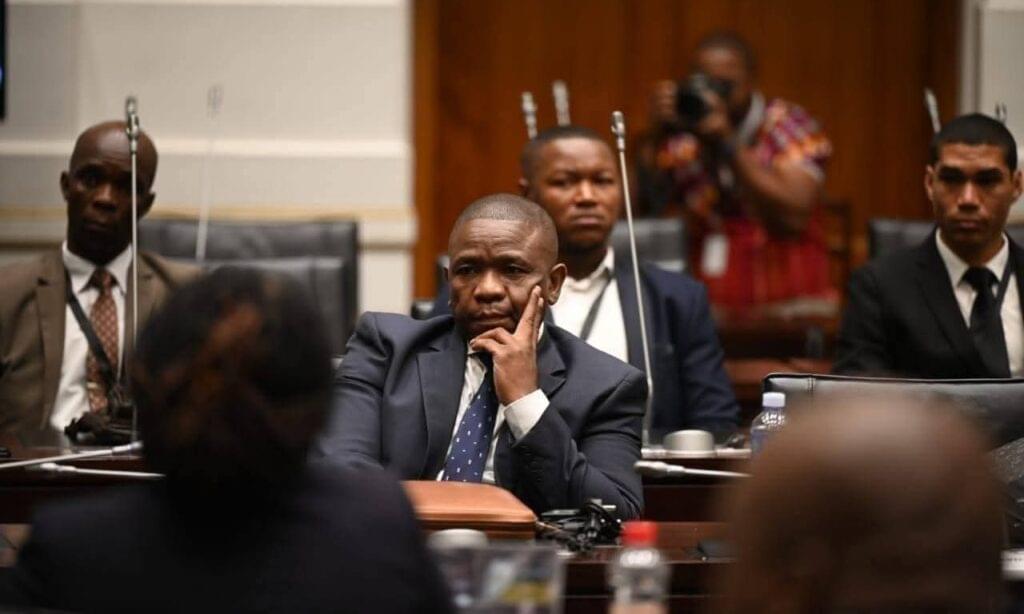
This follows testimony made by KwaZulu-Natal Provincial Commissioner, Lieutenant General Nhlanhla Mkhwanazi, before the parliamentary ad hoc committee’s inquiry into police corruption.
In a press release issued, the provincial government said it has no intention of litigating sweeping statements. However, it rejects the assertion that the formation of the Traffic Wardens showed contempt for the rule of law and categorically dismisses the allegation that the Gauteng Traffic Wardens are an illegal entity.
According to GPG spokesperson, Elijah Mhlanga, in December 2023, Justice and correctional services minister, Ronald Lamola, officially designated the Crime Prevention Wardens as Peace Officers in terms of Section 334 of the Criminal Procedure Act of 1977.
Adding that this legal designation granted them the same legal status as Gauteng traffic officers.
“The Gauteng Traffic Wardens initiative was always grounded in the principles of the South African Constitution, which mandates cooperative governance and requires all spheres of government, national and provincial, to “cooperate with one another in mutual trust and good faith.”
“The provincial government created the Traffic Wardens program to support and assist the national police (SAPS) in their duties, not to replace them or interfere with the authority of other government bodies.
“This was in response to statistics that showed that the police-to-citizen ratio in the province was one officer for every 541 residents in a population of about 16 million and growing,” he remarked.
Mhlanga stated that to achieve this, the province explored a cooperative policing model that is already used successfully in other parts of the country.
He added; “This model has allowed other spheres of government to develop policing protocols with the South African Police Service (SAPS), enabling locally funded policing initiatives to operate legally under SAPS authority and supervision.
“The Gauteng Government had always understood, even at the conceptual stage, that a potential pathway existed despite legal impediments.
“This pathway was Section 334(1)(a), which empowers the Minister of Justice and Correctional Services to confer peace officer status on any person by virtue of their office, granting them power under the Criminal Procedure Act for any offence or designated class of offences.
“Policing in South Africa had already demonstrated that decentralised structures with limited powers could coexist with the SAPS.
“Examples include the provincially funded Western Cape Law Enforcement Advancement Plan (LEAP), which deploys officers alongside the SAPS, Traffic Officers in provinces, and the various Metropolitan Police services.”
Characterisation of AmaPanyaza
Mhlanga highlighted that the traffic warden program followed a similar, cooperative policing framework.
“Its mandate was to collaborate with other law enforcement organisations, focusing on Townships, Informal Settlements, and Hostels (TISH) as priority areas. In these areas, the wardens provide visible policing, improved response times, and implement localised crime prevention strategies.
“The characterisation of the Gauteng Crime Prevention Wardens as “illegal”, therefore, distorts the facts and ignores the constitutional duty of the province to protect its residents.
“The Traffic Wardens are a legitimate, legally designated unit, established out of necessity and in the spirit of cooperative governance,” he stressed.
ALSO READ | Portfolio committee calls for swift action following SIU report on Tembisa Hospital loot
Meanwhile, the EFF in Gauteng maintained that it had long raised similar concerns in the provincial legislature regarding the establishment of this unit, which emerged on the eve of the 2024 National and Provincial Elections.
Our primary questions have always been – Firstly, on what budgetary basis was this unit established, asked Nkululeko Dunga, provincial chairperson.
“This concern arose from suspicions that the creation of the Traffic Wardens was not a sustainable, long-term employment initiative, but rather an electioneering tool by the ANC to solicit votes through false promises of permanent jobs.
“Secondly, what is the operational and legal standing of the unit. Since its launch, there has been widespread confusion about the roles, powers, and responsibilities of the so-called Crime Prevention or Traffic Wardens, compounded by serious doubts about their training, authority, and safety on the
ground,” he expressed.

Creative | Nerd | Media Junky | Scribe |
Bitten by a media bug in the late 90’s – As a bona-fide Journo, he boast extensive expertise in print, online and broadcast medium and continues to strive to be the best version of himself.