![vmexsa logo [front]](https://vmex.co.za/wp-content/uploads/2023/06/cropped-cropped-cropped-front-1-scaled.webp)
The 2026 local government elections silly season is officially upon us, writes Lesego Letswalo.
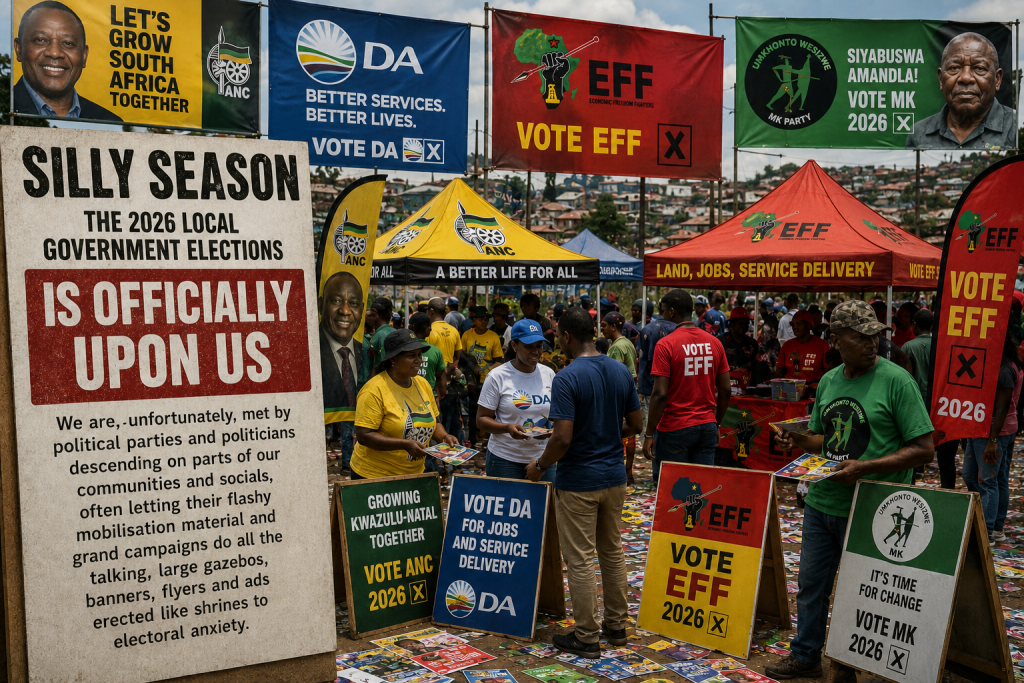
We are, unfortunately, met by political parties and politicians descending on parts of our communities and socials, often letting their flashy mobilisation material and grand campaigns do all the talking, large gazebos, banners, flyers and ads erected like shrines to electoral anxiety.
Thanks to efforts by civil society – we are now exposed to the real cost of all of this, with some political parties having declared their funding, with the DA declaring over R50 million in donations for the 2025–2026 financial year alone.
We no longer have to wonder how resourceful the political market is, but all of it is to flash spectacle at communities that have been bankrupt through decades of civic atrophy.
It turns out that elections say far more about a politician’s ability to raise money than their commitment to building the communities they claim to represent.
For the ANC, this bankruptcy follows a predictable post-liberation trajectory. Wherein once liberation movements became governing parties, the incentive to maintain grassroots infrastructure collapsed.
Power moved upward into parliament, into municipalities, and into tenders. The branch became a patronage vehicle rather than a community organ for nation building. The people became a constituency to be managed, not a community to be served.
The opposition, on the other hand, has spectacularly failed to offer an alternative. The obsession with removing the ANC has produced a rather comical irony: most opposition parties are simply trying to beat the ANC at its own game.
The electoral clientelism is identical—engage communities transactionally, offer short-lived rewards like food parcels, service delivery sloganeering, a borrowed gazebo, then disappear until the next cycle. This is precisely the toxic relationship South Africans have endured since 1994.
Panic ahead of silly season
What we are about to witness over the coming months is not energy. It is panic. A panic dressed in party colours, scrambling to mobilise people through spectacle rather than substance, through promises rather than commitment.
If our communities are not wary of this, we will continue feeding a patronage democracy where governance is structured around rewarding loyalty rather than serving constituents, where the politically connected flourish while the majority is deliberately reduced to instrumental community relations as means to electoral ends, never ends in themselves.
Only to be left vulnerable to opportunistic grandstanding that mobilises frustration rather than building genuine political cause for nation building.
The decay in South Africa’s nation-building project is not a new story. It is a predictable African tale. Zimbabwe offers us not a foreign cautionary tale but a mirror.
A liberation movement that captured the state allowed civic infrastructure to collapse and replaced governance with patronage until the political elite grew rich at the direct expense of a majority left to fend for themselves.
Many of those people now find themselves here, in our streets, in our communities, trying to survive.
And yet, rather than reading Zimbabwe as a warning about where our own governance failures lead, we find ourselves pointing fingers at its most vulnerable citizens.
The same communities being failed by electoral clientelism, by civic atrophy, and by politicians who only arrive with gazebos every five years are the same communities now demanding that African foreign nationals go home.
This is a political irony for the books! That the victims of governance failure are directing their frustration at the victims of governance failure.
ALSO READ | OPINION | Ethical and capable personnel essential for Madlanga Commission courts
This is what happens when structural understanding is replaced by spectacle and when nobody builds the civic literacy that helps communities identify the actual source of their frustrations.
So even as communities rightfully blue-tick politicians, we must also turn inward toward one another. The work of building solid communities can no longer wait for an election cycle.
It must be built through collective responsibility built by rituals for consistent community engagement that builds trust and common purpose.
Through rhythms for a shared sense of belonging that gives people identity and dignity beyond the ballot box. And through rules for order and discipline that hold communities accountable to each other, not just to a party manifesto every five years.
If South Africans do not reclaim this, we risk finding ourselves further dispossessed not only of resources and dignity but also of the very democratic foundation that separates our story from the ones we fear becoming.
Lesego Letswalo is a researcher at the City of Tshwane. Writing in her personal capacity.
Disclaimer: The views expressed in the content belong to the author and not vmexsa, its affiliates, or employees.